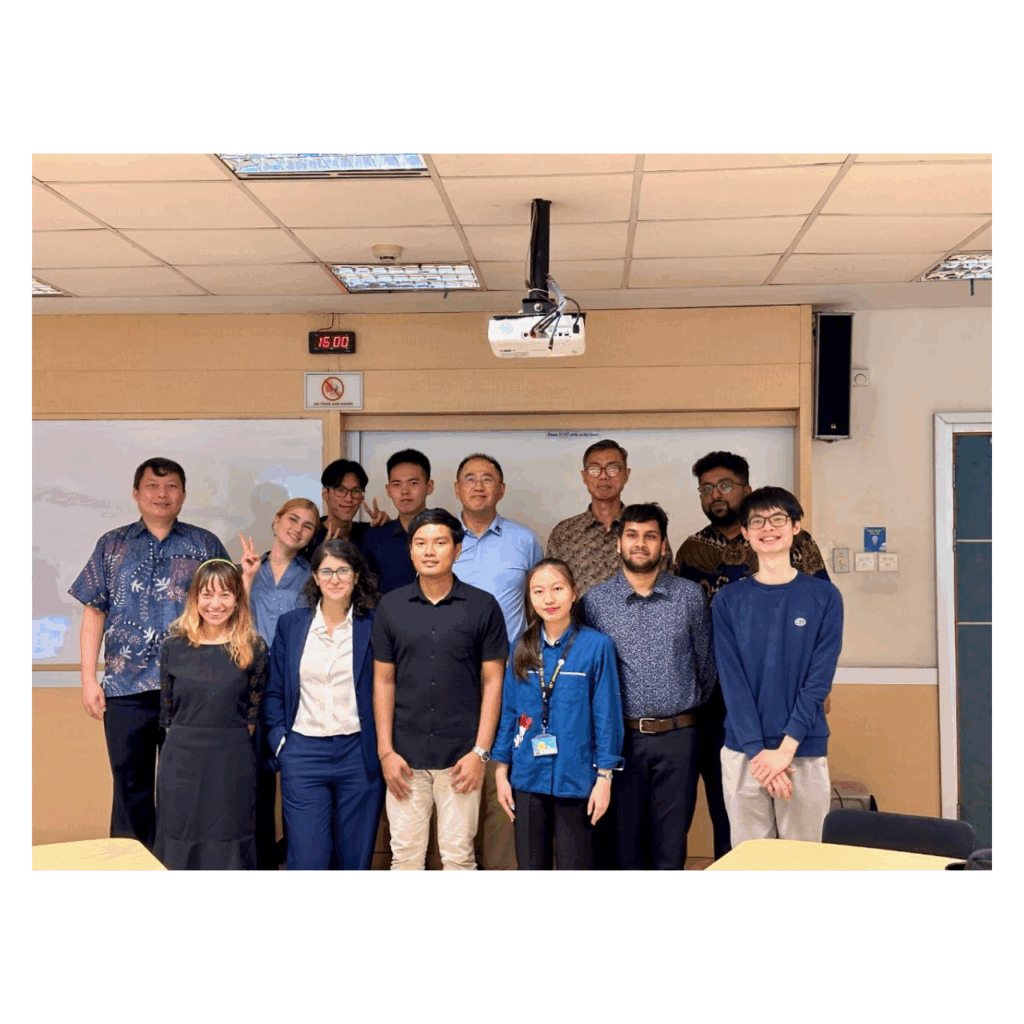
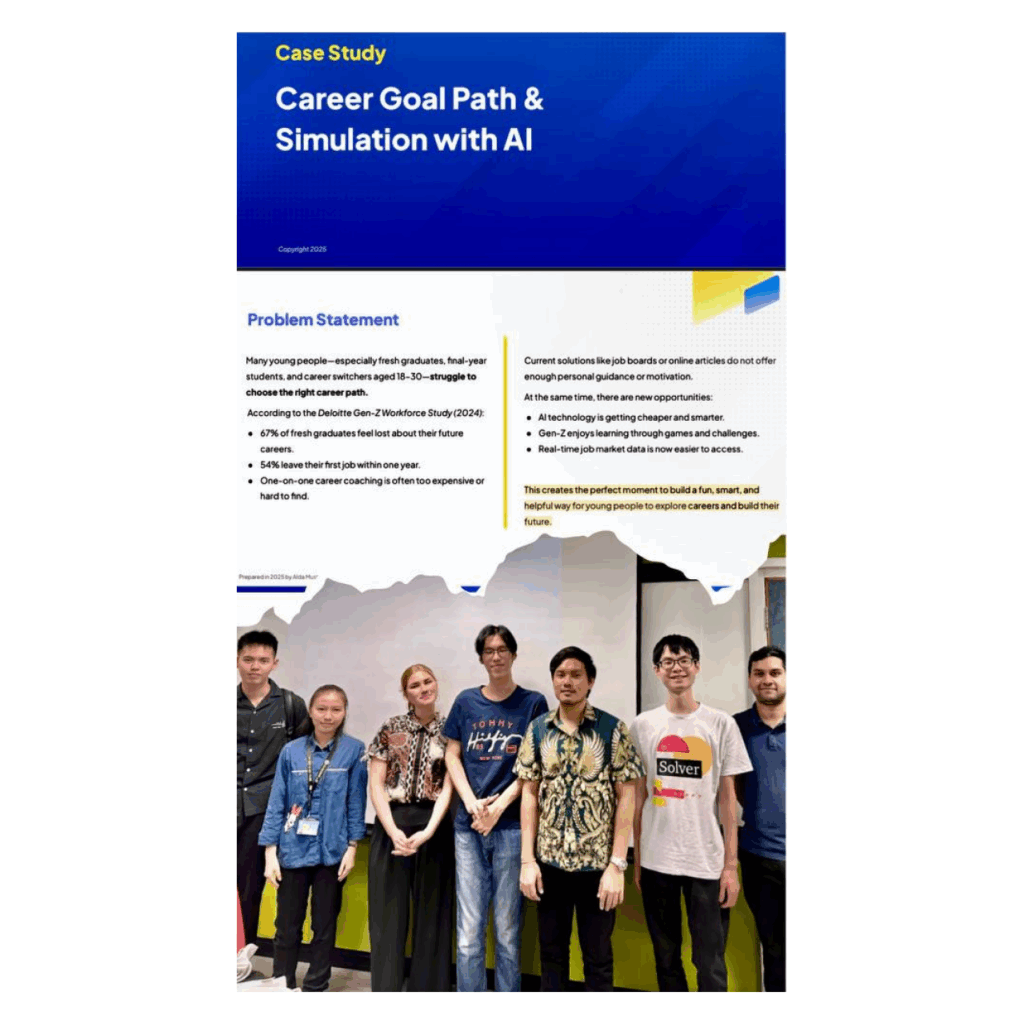
This July, I had the incredible opportunity to serve as a speaker, group mentor, and panel judge at a collaborative program between Binus University (Indonesia) and Macquarie University (Australia). The initiative, hosted under the Center for Innovation, Design, & Entrepreneurship Research (CIDER), challenged multidisciplinary student teams to tackle a real-world problem in career development through user-centered design.
The Challenge
The brief was rooted in a critical problem faced by many young people today: choosing the right career path. According to the 2024 Deloitte Gen-Z Workforce Study:
- 67% of fresh graduates feel lost about their future careers.
- 54% leave their first job within the first year.
- One-on-one coaching is often expensive or inaccessible.
Students were asked to design a solution that would help Gen-Z users navigate career exploration in a more personalized, engaging, and accessible way.
The Task: Designing a Career Simulation Platform
In this project, students were asked to prototype an AI-powered, game-based career simulation feature for Karier.mu, an Indonesian career platform. The goals were ambitious:
- Improve career clarity through personalized assessments.
- Drive user engagement via gamified journeys.
- Support job readiness with AI-driven learning paths and job recommendations.
My Role
As a facilitator, I delivered a session on user-centered design in career tech. I also served as a mentor for multiple student teams, providing feedback during design critiques and mid-sprint reviews. Finally, I joined the panel of judges during the final presentation sprint to evaluate their UI/UX prototypes, storytelling, and technical reasoning.
Highlights from the Student Projects
Each team brought something unique:
- Some focused on gamification to increase daily engagement and quest participation.
- Others emphasized community-based learning, grouping users by shared interests.
- Many built impressive end-to-end journeys—from onboarding and assessment to personalized dashboards and job recommendation pages.
The final prototypes showcased high levels of creativity, research depth, and a clear understanding of user needs.
Metrics-Driven Thinking
One of the best parts of the program was watching students make decisions driven by clear KPI targets, such as:
- +50% Daily Active Users
- +25% Course Completion Rate
- +20% Job Application Click-through
It was exciting to see how design choices could be mapped to real business and impact outcomes.
Reflections
This program reminded me how powerful collaborative, project-based learning can be. It was a joy to see students from different cultural and academic backgrounds collaborate, iterate, and build solutions that could genuinely help their peers.
I’m grateful to the teams at Binus, Macquarie, and CIDER for trusting me with this opportunity. And to the students—thank you for your hard work, curiosity, and willingness to grow.
Final Note
To all aspiring designers out there: Real impact comes from understanding people deeply, building with empathy, and designing with purpose. This project was a powerful reminder of that.